How to Remove Moss & Algae from Steps & Patios (Safely)
How to remove moss from patio and steps safely: manual removal, the best treatments, myths about vinegar and soda, and how to stop it growing back.
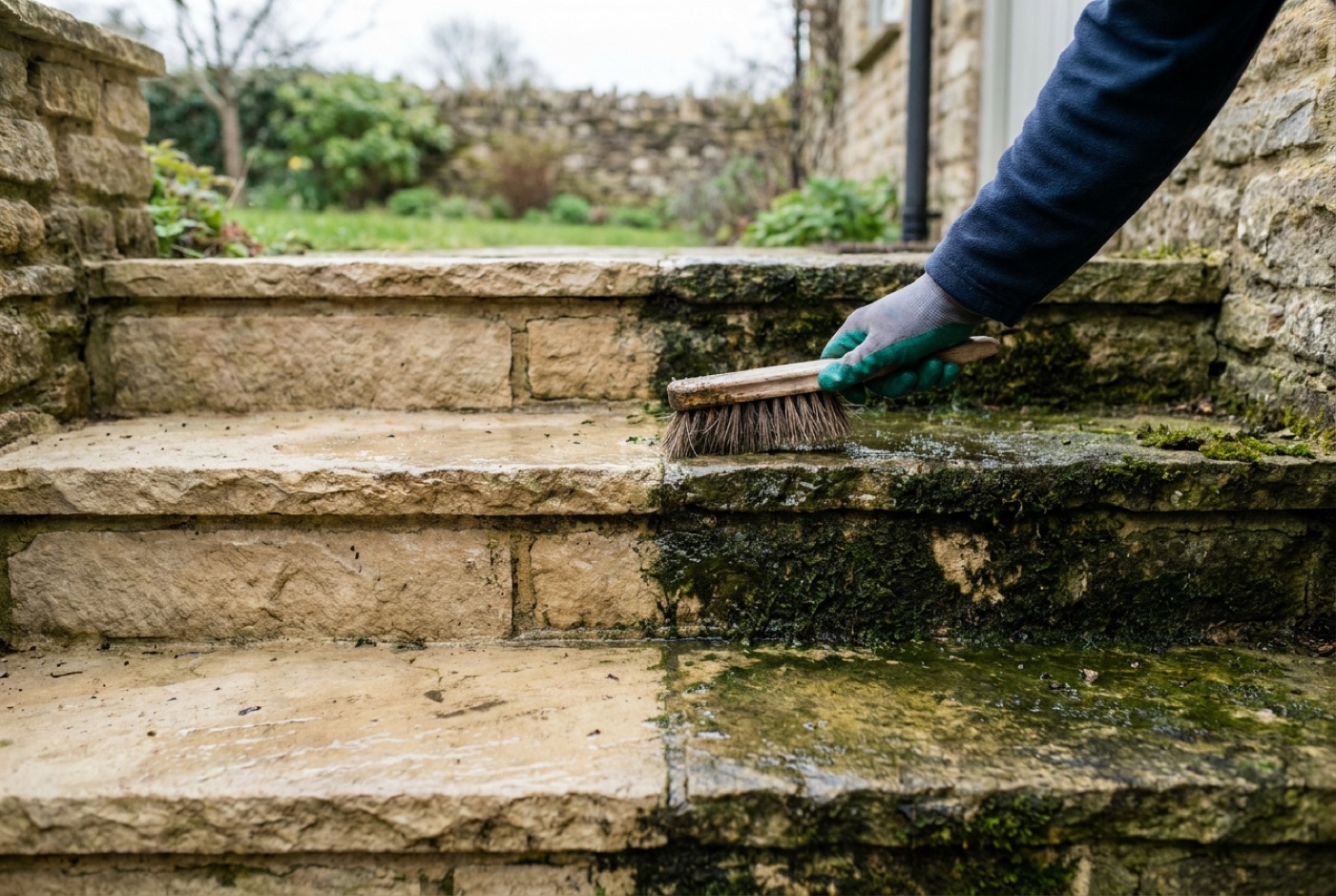
If you want to remove moss from patio slabs and steps and actually keep it gone, the trick is to treat the cause, not just scrape off the symptom. Moss and algae aren’t dirt — they’re living plants that colonise any surface that stays damp and shaded, which describes most British steps for a good half of the year. Left alone they don’t just look tired: the green film is what turns stone steps genuinely dangerous underfoot, and moss packed into the joints traps water that slowly works the pointing loose. The good news is that both clear up with cheap, simple methods once you understand what you’re dealing with. This guide covers why moss and algae grow, how to remove them by hand and with the right treatment, which “natural” remedies actually work, the real risks of a pressure washer, and how to stop the green coming straight back.
Why moss and algae grow on steps and patios
Moss and algae are opportunists. Give them the three things they need — moisture, shade and a slightly rough surface to grip — and they’ll settle within a season. Understanding the conditions tells you exactly why they keep coming back.
- Damp that never dries. North-facing steps, shaded corners under trees and low spots where water pools stay wet long enough for spores to establish. A surface that dries out within an hour of rain rarely goes green.
- Poor drainage. Steps that hold a puddle, or a patio laid dead flat with no fall, are moss factories. Water sitting in the joints is the single biggest driver of moss.
- Shade and low light. Algae and moss cope fine without direct sun; the plants that would compete with them (grass, weeds) can’t, so the green wins by default.
- A porous, textured surface. Sandstone, riven York and worn concrete give spores plenty of grip. Dense, smooth stone like polished granite or slate resists colonisation for longer.
- Organic film. Fallen leaves, tree sap, pollen and general grime form a thin organic layer that moss and algae feed on. This is why steps under a tree go green faster than open ones.
Get the diagnosis right before you treat, because moss and algae respond a little differently — and the black, crusty patches you sometimes see alongside them are lichen, which is more stubborn again.
Moss vs algae vs lichen — telling them apart
| Growth | What it looks like | Where it lives | How hard to remove |
|---|---|---|---|
| Algae | Thin green, slimy film; slippery when wet | Whole surface, especially shaded slabs | Easy — a biocide and a wash |
| Moss | Soft, spongy green cushions | Joints, edges, low spots that hold water | Moderate — scrape then treat |
| Lichen | Flat grey, white or black crusty spots | Baked onto the surface of the stone | Hard — needs biocide and patience |
Algae is the slippery green film; moss is the spongy green cushion in the gaps; lichen is the flat crust that laughs at a stiff brush. For the black-spot lichen in particular, our guide to cleaning stone steps and patios goes into more depth on stubborn biofilms.
Removing moss and algae by hand
Manual removal is where every job should start. It’s free, it does no harm to the stone, and clearing the bulk of the growth first means any treatment you apply afterwards works far better. Pick a dry day so you’re not just spreading slurry around.
1. Scrape moss out of the joints
Moss holds hard in the gaps between slabs and on step nosings. A block paving knife, an old chisel or a stiff paint scraper drags it out cleanly. Work along each joint and lift the moss out in strips. For a large patio, a long-handled patio weeding tool saves your back.
2. Brush off the algae film
Once the joints are clear, attack the algae with a stiff-bristled deck brush — never a wire brush, which scratches soft stone and leaves rust marks. Scrub in the direction of the slab, working the film loose. On steps, work top to bottom so dirty water runs down onto surfaces you haven’t cleaned yet.
3. Rinse and assess
Rinse the loosened debris away with a hose or a bucket of water and see what’s left. Fresh algae often comes away with the brush alone. If a green stain or a grey lichen crust remains, that’s the job for a chemical treatment — brushing alone won’t shift growth that’s rooted into the surface.
Manual removal on its own is a temporary fix: you’ve taken off the top growth but left the spores behind, so it grows back within weeks. To keep it gone, follow up with a biocide.
The best treatments to remove moss and algae
For anything more than a light film, a proper treatment does the work that scrubbing can’t — it kills the plant at the root so it doesn’t regrow. Here are the options that actually work, and the ones that don’t.
Patio and path biocide (the reliable choice)
A dedicated patio cleaner / path biocide is the workhorse. Most are based on either benzalkonium chloride or a similar quaternary-ammonium biocide, and they’re formulated to kill moss, algae and lichen without acid that would etch the stone. You dilute per the label, apply with a watering can or sprayer, and — crucially — leave it to work. Many are “apply and leave”: the rain does the rinsing, and the growth dies back and weathers off over one to four weeks rather than vanishing instantly. They’re the best all-rounder because they’re safe on virtually all stone and keep working for months, delaying regrowth.
Sodium hypochlorite (bleach) — effective but use with care
Ordinary sodium hypochlorite (the active ingredient in thin bleach and many “patio blackspot” removers) is cheap and hits algae and lichen hard. It works, but it carries real cautions:
- Dilute it — a rough guide is one part bleach to four parts water — and always test an out-of-the-way patch first, because it can lighten coloured sandstone and leave pale patches.
- Protect surrounding planting. Bleach run-off will scorch or kill lawn, borders and pond life. Pre-wet nearby plants, cover them, and never use it where run-off drains straight into a pond.
- Rinse thoroughly afterwards, and never mix it with any acidic cleaner (that releases toxic chlorine gas).
- Don’t use it on polished or coloured stone where a pale patch would show. For a valuable riven sandstone patio, a proper biocide is safer.
Used carefully on the right stone it’s brutally effective; used carelessly it bleaches your patio and kills your borders.
Vinegar, salt and soda — the myths worth skipping
The internet is full of “natural” patio recipes. Most are weak, and some do harm:
- Vinegar (acetic acid) will burn back surface algae, but it’s acidic — so on limestone, York stone and any calcium-based stone it etches and dulls the surface permanently. It’s also a poor moss killer and washes away fast. Skip it on natural stone.
- Baking soda / bicarbonate of soda does very little to established moss. It’s a gentle abrasive at best, not a biocide.
- Salt kills moss but poisons the soil for years and can cause white efflorescence bloom to migrate through the stone. Keep it well away from paving.
- Boiling water genuinely works on small patches — it cooks the moss — and is a fine, chemical-free option for a few joints or a doorstep, just not practical for a whole patio.
If you want a genuinely low-tox route, boiling water plus manual scraping plus a plant-safe biocide beats every kitchen-cupboard recipe going.
Pressure washing — helpful, but handle with care
A pressure washer is the quickest way to blast off a thick green carpet, and on hard, dense stone it’s fine — but it’s also the fastest way to wreck a soft patio. The problems are real:
- On sandstone, limestone and reclaimed York, a close jet pits and “furs up” the surface, leaving it rougher — which ironically makes it colonise with moss faster next time.
- It blasts sand and mortar out of the joints, which then need re-filling, and can lift loose slabs entirely.
- It only removes the top growth. Without a follow-up biocide, the spores survive and the green is back within weeks.
If you do use one, fit a fan tip (never a pin-point turbo nozzle), keep it at least 30cm from the surface, and keep the lance moving so you don’t stripe the stone. On any soft or valuable stone, a biocide and a stiff brush give a better, safer, longer-lasting result. Our full guide to cleaning stone steps and patios covers pressure-washing technique per stone type in more detail.
Preventing moss and algae from coming back
Removal is half the job. Because moss and algae are driven by damp and shade, the lasting fix is to change the conditions so they can’t re-establish. A patio you treated once and then sealed and drained properly stays clean for years; one you just scrubbed goes green again by next autumn.
Fix the drainage and let it dry
Water sitting on the surface is the root cause. Clear blocked joints and gullies so water can drain, and if a step or slab holds a puddle every time it rains, that low spot needs lifting and re-laying to a slight fall. Cut back overhanging branches and thin out shrubs so more light and air reach the stone and it dries faster after rain — a surface that dries within an hour rarely goes green.
Seal the stone
Sealing is the single most effective preventative. A good sealer reduces the stone’s porosity so it holds less water and gives spores far less to grip, which means slower regrowth and much easier cleaning when it does. Choose an impregnating (breathable) sealer with a natural matt finish — a glossy “wet-look” seal can be slippery underfoot on steps, which is exactly what you don’t want. See our guide to the best stone sealers for steps and patios for how to pick and apply one, and re-seal every three to five years or when water stops beading and starts soaking in.
Keep on top of it
- Sweep regularly, especially through autumn — wet leaves are what feed algae over winter.
- Apply a maintenance biocide once or twice a year on shaded surfaces before the green takes hold; a light preventative dose is far easier than a full deep clean.
- Rinse and re-treat joints where moss always returns first.
Keep steps grippy in the meantime
Because algae is what makes stone slippery, a shaded flight of steps can be a genuine hazard even between cleans — most autumn slips are on that green film, not on ice. If your steps are north-facing or under trees and never quite dry out, it’s worth fitting proper non-slip stone step treads as a belt-and-braces safety measure while you get the growth under control.
Per-stone notes
The method is broadly the same across materials, but a few stones need care:
- Sandstone (including Indian sandstone and York): porous and prone to going green, so it’s the material that most rewards sealing. Use a proper biocide rather than strong bleach, which can lighten the colour, and never a pin-point pressure jet.
- Limestone: soft and acid-sensitive — no vinegar, no acidic cleaners, and a gentle fan-tip only. A pH-neutral biocide is the safe route.
- Slate: dense and low-porosity, so it colonises more slowly, but its riven texture traps algae in the ridges. A stiff brush and biocide clears it well; it takes bleach better than sandstone but still test first.
- Granite: the toughest of the lot. It tolerates pressure washing and bleach best, though a fan tip and a rinse are still sensible. Rarely needs sealing for moss reasons.
- Concrete slabs: porous and rough, so they go green readily. Treat like sandstone — biocide, brush, seal — and expect to re-treat more often on shaded areas.
FAQ
What is the best thing to remove moss from a patio?
For most patios a dedicated patio biocide (an apply-and-leave path/patio cleaner) is the best all-round choice: it kills moss, algae and lichen at the root, is safe on virtually all stone, and keeps working for months to delay regrowth. Scrape the bulk of the moss out of the joints by hand first, then treat, then rinse. It’s more reliable and longer-lasting than a pressure washer alone.
Does bleach kill moss and algae on stone?
Yes — sodium hypochlorite (bleach) kills moss, algae and lichen effectively — but use it with care. Dilute it (roughly one part bleach to four parts water), test an inconspicuous patch first because it can lighten coloured sandstone, protect surrounding plants from run-off, and rinse well. Never mix it with acidic cleaners. On valuable or coloured stone, a proper biocide is the safer choice.
Will vinegar remove moss from a patio?
We don’t recommend it on natural stone. Vinegar is acidic, so while it burns back surface algae it also etches and permanently dulls limestone, York and other calcium-based stone. It’s a weak moss killer and washes away quickly. For a chemical-free option, boiling water on small patches works better and does no lasting harm; for larger areas use a proper biocide.
Why does moss keep growing back on my steps?
Because the underlying conditions haven’t changed. Moss thrives on damp, shade and poor drainage, so if your steps stay wet, sit in shade, or hold water in the joints, the spores re-establish within weeks even after a thorough clean. The lasting fix is to improve drainage, cut back overhanging growth so the stone dries faster, and seal the stone to reduce how much water it holds.
Is a pressure washer safe for removing moss?
Only on hard, dense stone like granite or fresh York, and only with a fan tip held at least 30cm back — never a pin-point turbo nozzle. On sandstone, limestone and reclaimed stone, a close jet pits the surface and blows the jointing sand out, and it roughens the stone so it colonises faster next time. For soft or valuable stone, a biocide and a stiff brush give a better and longer-lasting result.
How do I stop my steps being slippery once the moss is gone?
The slipperiness comes from the algae film, so keeping the stone clean, well-drained and sealed with a matt (not glossy) sealer is the main answer. For north-facing or tree-shaded steps that never fully dry, add proper non-slip step treads for extra grip. A light biocide once or twice a year keeps the green from returning before it becomes a hazard.