Natural Stone vs Porcelain vs Concrete for Steps & Patios
Natural stone vs porcelain vs concrete for steps and patios: compare grip, durability, water absorption, looks, maintenance, sealing and cost.
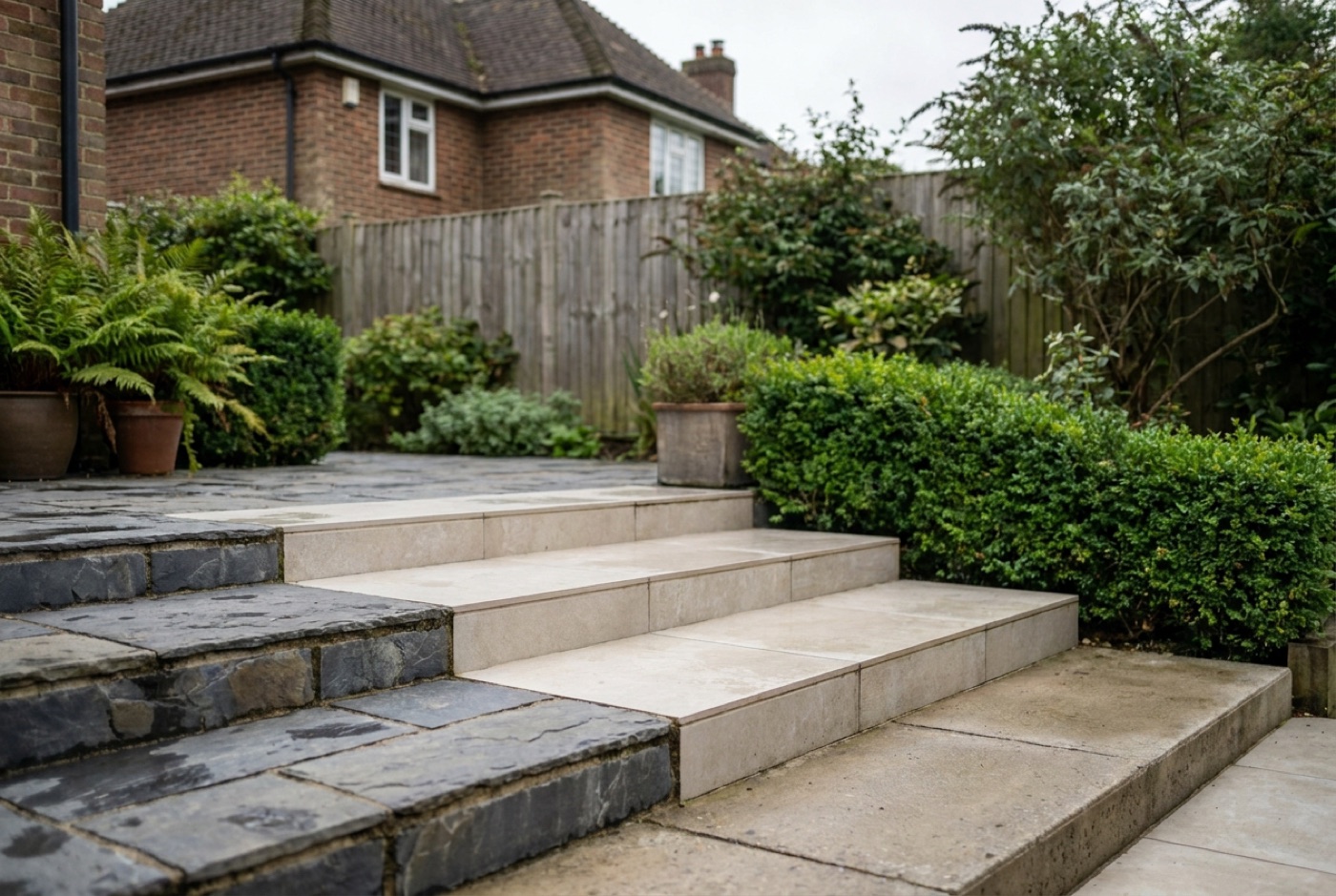
The natural stone vs porcelain vs concrete question is the one nearly every step and patio project comes down to, and the honest answer is that all three are good — they’re just good at different things. Natural stone gives you genuine character and warmth that ages beautifully. Porcelain is the low-maintenance, stain-proof modern option. Concrete is the affordable, made-to-any-shape workhorse. The right choice depends on how the steps will be used, how much grip and upkeep you’re willing to trade for looks, and your budget. This guide puts the three head to head on the things that actually matter underfoot — grip, durability, water absorption, appearance, maintenance and cost — and then tells you which to pick for your specific situation.
Natural stone vs porcelain vs concrete: at a glance
Here’s the whole comparison on one screen before we get into the detail. Treat it as a shortlist, not a verdict — the “best” column changes depending on your priorities.
| Factor | Natural stone | Porcelain | Concrete |
|---|---|---|---|
| Look | Genuine, varied, ages with character | Uniform, modern, huge range of finishes | Uniform; from plain grey to stone-effect |
| Grip on steps | Very good (riven/flamed) | Very good with an R11/R12 anti-slip finish | Good; depends on the finish/texture |
| Water absorption | Medium–high (porous) | Near-zero (under 0.5%) | Medium |
| Durability | High (decades–centuries) | Very high; scratch & frost resistant | High; can crack/spall over time |
| Staining | Stains if unsealed | Virtually stain-proof | Stains and marks unless sealed |
| Sealing needed | Yes (most stones) | No | Recommended |
| Frost resistance | Good–excellent (varies by stone) | Excellent | Good if made well |
| Fading (UV) | Minimal | None | Coloured/pigmented can fade |
| Weight/handling | Heavy | Lighter than stone | Heavy (cast in situ) or modular |
| Cutting on site | Straightforward | Hard — needs diamond blades | Easy for cast; slabs cut like stone |
| Relative cost (material) | Mid–premium | Mid–premium | Budget–mid |
| Best for | Character, heritage, garden steps | Low-maintenance modern patios & steps | Value, custom shapes, high traffic |
Every one of those rows deserves a closer look, because a single number rarely tells the whole story. Let’s go through them.
Grip and safety
On steps, grip beats everything. A beautiful surface that turns into an ice rink in a wet British October is a false economy, so this is where you should focus first.
- Natural stone grips well when you choose the right finish. A riven (naturally split) sandstone or a flamed granite has a textured face that sheds water and holds a shoe. A honed or polished finish, by contrast, is slippery when wet and belongs indoors. See our best non-slip stone step treads guide for how finish and nosing choice affect safety.
- Porcelain is engineered for grip. Outdoor “structured” or “grip” porcelain is rated on the R-scale (R11–R12 for steps and wet areas) and the pendulum test, so you can buy a known, certified slip performance — something natural stone can’t promise batch to batch. This is porcelain’s quiet superpower on steps.
- Concrete depends entirely on how it’s finished. A broom-finished, exposed- aggregate or textured cast concrete step grips very well; a smooth power-floated or sealed-glossy one can be slick. You have full control if it’s cast on site.
Verdict: porcelain wins for guaranteed, rated slip resistance; a well-chosen riven or flamed natural stone is a very close second; concrete matches either if it’s finished with grip in mind.
Durability and lifespan
All three will outlast a timber deck comfortably. The differences are about how they age and what can go wrong.
- Natural stone is the long-game champion. York stone steps laid a century ago are still in service, and stone simply gets more characterful with age. The caveats: softer stones (some limestones, cheaper sandstone) can spall or flake in hard frost if they’re saturated, and reclaimed stock can be inconsistent.
- Porcelain is astonishingly tough for its thickness. It’s fired at very high temperatures, so it’s dense, scratch-resistant, frost-proof and won’t fade in UV. The weak point is impact on edges and corners — a dropped slab or a knock to an unsupported nosing can chip it, and a chip in porcelain shows the body colour underneath.
- Concrete is durable and predictable when it’s mixed, reinforced and cured properly, which is why it’s the default for busy public steps. Its failure modes are cracking (from movement or poor sub-base), surface spalling in frost, and pigment fade on coloured mixes. Good drainage and a decent mix design prevent most of it. Our concrete garden steps guide covers how they’re made to last.
Verdict: natural stone for sheer longevity and graceful ageing; porcelain for scratch/frost/fade resistance; concrete for dependable heavy-traffic performance.
Water absorption — the number that explains a lot
Water absorption drives staining, frost damage, algae growth and how much upkeep a surface needs, so it’s worth understanding.
- Porcelain absorbs almost nothing — typically under 0.5%. Water sits on top and evaporates. That single fact is why porcelain doesn’t stain, doesn’t need sealing, resists frost and grows far less algae.
- Natural stone varies enormously. Dense granite and slate absorb very little; sandstone and limestone are far more porous and drink up water, wine, oil and leaf tannin unless sealed. Porosity is the reason most natural stone needs a sealer — see our slate steps and paving guide and Indian sandstone guide for how two stones at opposite ends of the scale behave.
- Concrete sits in the middle. Bare concrete is porous enough to stain and to hold moisture that feeds algae and drives frost spalling, which is why sealing a concrete step or patio is worthwhile even though it’s not strictly essential.
Verdict: porcelain is in a class of its own; among natural stones, granite and slate rival it while sandstone and limestone need sealing to compete.
Appearance
This is subjective, but the practical differences are real.
- Natural stone is the only one of the three that’s genuinely natural — every slab is unique, the colour has depth, and it weathers into a patina that a factory can’t replicate. For a period property, a cottage garden or a heritage entrance, nothing else looks as right. See the York stone steps and paving guide for the classic British look.
- Porcelain is uniform and comes in a vast range of finishes, including stone-effect and wood-effect prints that are convincing at a glance. The look is crisp, contemporary and consistent — which is exactly the appeal for a modern home, but can read as slightly “flat” up close next to real stone because every slab is identical.
- Concrete ranges from honest plain grey (which looks great in a minimalist or brutalist scheme) to cast or pressed “stone-effect” and exposed-aggregate finishes. It’s the most malleable — you can cast bullnose nosings, curves and bespoke widths that would cost a fortune in stone.
Verdict: natural stone for authentic character; porcelain for uniform modern looks; concrete for design flexibility and honest, budget-friendly minimalism.
Maintenance and sealing
How much of your weekend each surface claims is a genuine deciding factor.
| Task | Natural stone | Porcelain | Concrete |
|---|---|---|---|
| Routine cleaning | pH-neutral cleaner + brush | Soap and water; almost anything | pH-neutral cleaner + brush |
| Sealing | Yes — most stones need it | No | Recommended |
| Re-sealing | Every 3–5 years | Never | Every few years |
| Stain risk | Higher if unsealed | Very low | Moderate if unsealed |
| Algae/green | Needs biocide on shaded areas | Less prone; still needs a wash | Prone on shaded, damp areas |
- Porcelain is the low-maintenance winner by a distance. No sealing, ever; spills wipe off; it grows less algae. A wash is usually all it needs.
- Natural stone rewards a little care. Seal it, sweep it, treat the green once or twice a year, and it stays beautiful for decades. Skip the sealing and porous stone stains and greens up fast. Our guides on cleaning stone steps and patios and choosing the best stone sealers for steps cover the routine.
- Concrete sits between the two: seal it to fend off oil stains and frost, keep it swept, and treat algae on shaded flights. Low effort, but not zero.
Verdict: porcelain for near-zero upkeep; concrete for low upkeep; natural stone for a modest routine that pays back in longevity and looks.
Cost
Prices move constantly, so we won’t quote figures, but the relative picture is stable and useful for planning.
- Concrete is usually the cheapest option, especially when cast in situ or bought as plain modular units. Stone-effect and specialist finishes narrow the gap.
- Natural stone spans a wide range: budget imported sandstone competes with concrete on material cost, while premium York stone, quality granite and reclaimed material sit at the top end.
- Porcelain tends to be mid-to-premium on material. It’s often more to lay than stone, because outdoor porcelain is hard, must be cut with diamond blades, usually needs a full mortar bed with a slurry primer, and step nosings are a specialist trade. Budget for the labour, not just the slabs.
A useful rule of thumb: concrete tends to win on upfront cost, porcelain on lifetime cost (no sealing, no re-doing), and natural stone on resale and kerb appeal. For a full breakdown of stone options and their costs, see our pillar guide to the best stone for garden steps.
Which should you choose? By scenario
Rules of thumb are more useful than a “winner”, so here’s how we’d steer each situation.
- A busy family patio you never want to think about → structured porcelain. Stain-proof, frost-proof, no sealing, rated grip — it just gets on with it.
- Steps for a period or character property → natural stone, sealed. York stone, riven sandstone or granite looks right where porcelain looks out of place.
- Tightest budget, or an awkward custom shape → concrete, cast in situ with a textured or bullnose finish. Best value and total design freedom.
- A shaded, north-facing, always-damp flight → porcelain or dense natural stone (granite/slate) — low water absorption means far less green to battle.
- Maximum grip for elderly or less-mobile users → structured porcelain (R12) or flamed granite with a contrasting nosing.
- You want it to look better in 20 years than it does today → natural stone, every time. It’s the only one that develops a patina rather than just wearing.
- Matching an existing modern, minimalist scheme → porcelain for uniformity, or plain concrete for an honest, architectural feel.
There’s no universally correct answer — but there’s almost always a clearly correct answer for your project once you rank grip, upkeep, budget and looks in order of what matters to you.
FAQ
Is porcelain or natural stone better for steps and patios?
Neither is universally “better” — they suit different priorities. Porcelain wins on low maintenance, stain resistance and certified slip ratings, making it ideal for busy, modern, hassle-free patios and steps. Natural stone wins on genuine character, longevity and the way it ages, making it the right choice for period properties and anyone who values authentic looks over minimal upkeep.
Is porcelain more slippery than natural stone?
Not if you buy the right grade. Outdoor “structured” or “grip” porcelain is manufactured with a textured surface and rated R11–R12, giving it excellent, certified wet grip that often beats natural stone. Only smooth, polished indoor porcelain is slippery outside — never use that on external steps. Likewise, a polished natural stone is just as slippery, so with either material the finish is what matters.
Does porcelain crack or fade like concrete?
Porcelain is highly resistant to both. It’s fired at very high temperatures, so it’s frost-proof, extremely hard and won’t fade in UV — unlike pigmented concrete, which can lighten over years. Porcelain’s main vulnerability is chipping on edges and corners from a hard impact, whereas concrete’s is cracking and surface spalling if it’s poorly mixed or badly drained.
Do you have to seal porcelain, stone and concrete?
Porcelain never needs sealing — its water absorption is under 0.5%, so nothing soaks in. Most natural stone does need sealing, especially porous sandstone and limestone, to prevent staining and slow algae; dense granite and slate need it less. Concrete doesn’t strictly require it, but sealing is recommended to resist oil stains, algae and frost damage.
Which is cheapest — stone, porcelain or concrete?
Concrete is usually the cheapest upfront, particularly cast in situ or as plain modular units. Natural stone ranges from budget imported sandstone (comparable to concrete) up to premium York stone and granite. Porcelain is typically mid-to- premium and often costs more to install than stone because it must be cut with diamond blades and needs a primed, full-mortar bed. Weigh upfront cost against porcelain’s near-zero lifetime maintenance.
Can you get porcelain and concrete that look like natural stone?
Yes — both offer convincing stone-effect finishes. Porcelain uses high-resolution prints that mimic sandstone, slate or travertine and look great from standing height. Concrete can be pressed, cast or colour-matched to resemble stone. Up close, though, neither has the true depth and slab-to-slab variation of the real thing, so if authenticity is the goal, genuine natural stone is still unbeaten.