Indian Sandstone for Steps & Paving: The Complete Guide
The complete guide to Indian sandstone for steps and paving — colours, riven vs sawn, porosity, sealing, efflorescence, durability, cost and maintenance.
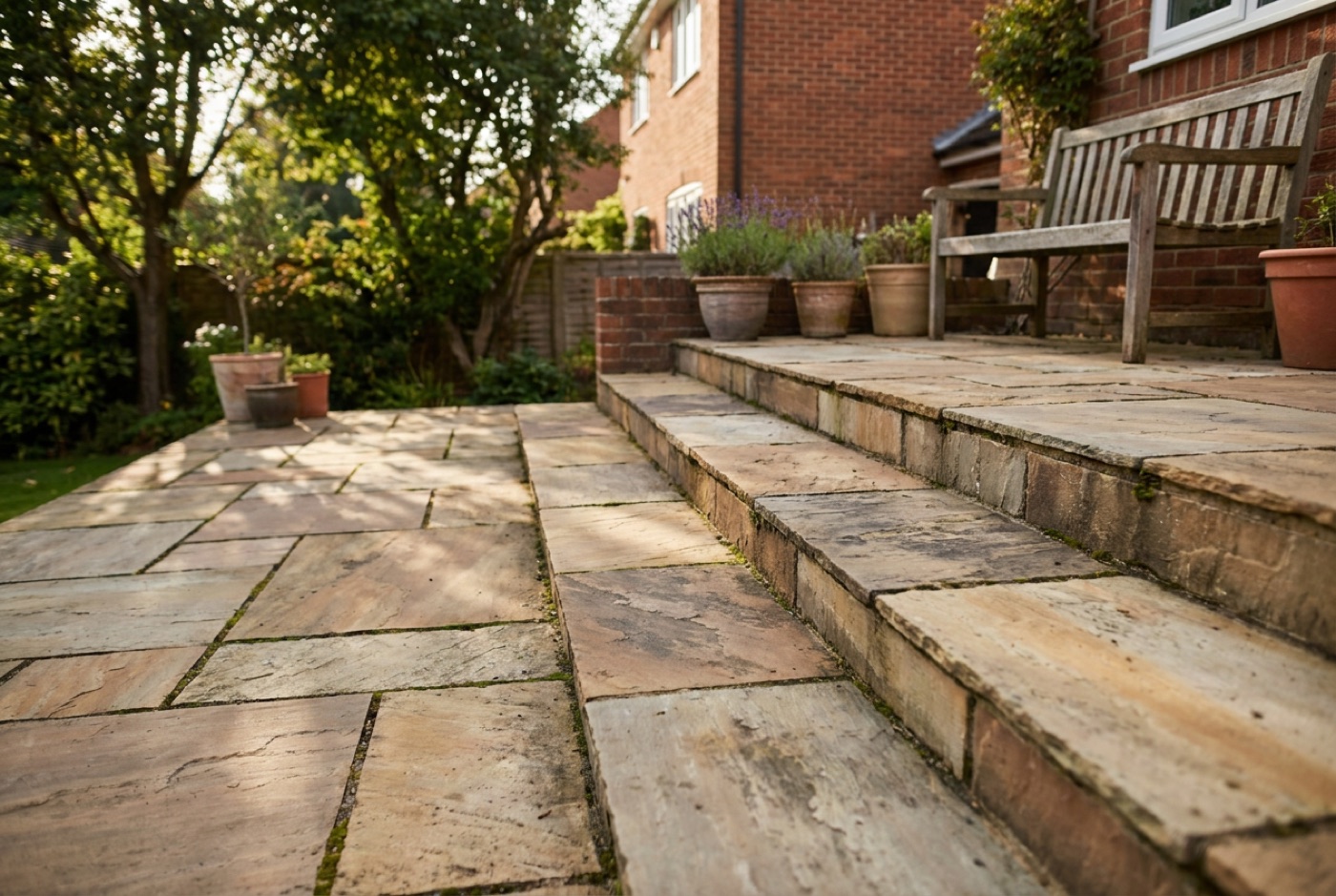
Indian sandstone is, by a distance, the most popular natural paving in Britain — and it has quietly become the default choice for garden steps too. Walk down any suburban street and you’ll see it: those warm, multi-toned riven slabs in front gardens, patios and step flights up and down the country. The reason is simple. Indian sandstone gives you real natural stone — with genuine colour variation, a honest riven texture and a proper stone feel underfoot — at a price that undercuts York stone, granite and porcelain. It is affordable, widely stocked and forgiving to lay. But it is also porous, prone to efflorescence and softer than the premium stones, so it rewards a bit of know-how. This guide covers everything: what Indian sandstone actually is, the colours, the finishes, the drawbacks and exactly how to keep it looking good for decades.
What is Indian sandstone?
Indian sandstone is a natural sedimentary rock, quarried mainly in the state of Rajasthan in north-west India and shipped to the UK as pre-cut paving slabs, step treads, copings and setts. It is formed from grains of quartz sand compressed and cemented together over millions of years, which is why you can often see faint layering, ripple marks and fossilised detail across the surface — the fingerprints of an ancient riverbed or seabed.
Because it is a sedimentary stone rather than an igneous one (like granite) or a metamorphic one (like slate), it sits at the softer, more porous end of the paving spectrum. That makes it easier to cut and lay, but also means it drinks up water and needs a little more care than the harder stones. If you’re weighing it against the alternatives, our guide to the best stone for garden steps puts Indian sandstone side by side with York stone, granite, slate and limestone.
Why is it so popular and affordable?
Three things drive the popularity:
- Cost. Large-scale quarrying and low production costs in India mean the finished, calibrated slabs land in UK builders’ merchants far cheaper than British-quarried York stone or granite — often at a third to a half of the price.
- Looks. You get natural colour variation and a riven surface that reads as genuine, characterful stone rather than a manufactured product. It suits both period and contemporary gardens.
- Availability. It is stocked everywhere, in consistent pack sizes and calibrated thicknesses, so a patio or step flight is easy to buy, plan and lay without hunting down a specialist supplier.
Indian sandstone colours
Colour is where Indian sandstone earns its keep — the range is genuinely broad, and because it is natural stone, every batch varies. Here are the colours you’ll actually be choosing between in a UK merchant’s yard:
| Colour | What it looks like | Best for |
|---|---|---|
| Raj Green | Warm mid-brown base shot through with green, buff and rust tones; very multi-toned | The best-selling all-rounder; period and cottage gardens |
| Autumn Brown | Rich browns, russets and chocolate tones; warm and mellow | Traditional gardens, warm-brick houses |
| Grey (Kandla / Silver Grey) | Cool, even blue-greys with subtle veining; more uniform | Contemporary schemes, grey render, modern extensions |
| Mint | Soft pale green-grey with cream and buff flashes; light and airy | Brightening shaded or north-facing gardens |
| Modak | Pale pink-buff and cream with soft peach tones; light and warm | Light, Mediterranean-feel patios and steps |
| Fossil Mint / Camel | Sandy buff and cream with fossil detailing | Neutral, blends with most house colours |
A word of realism: because it is natural stone, the slabs in your pack will not all match the display board exactly. That variation is the whole point — but if you want a tighter, more uniform look, lean towards the greys and mints, which tend to vary less than Raj Green.
Riven vs sawn Indian sandstone
The finish matters as much as the colour, and it changes the price, the look and how the stone behaves underfoot.
-
Riven (natural split). The traditional finish. The slab is split along its natural bedding plane, leaving an uneven, textured, slightly undulating surface. It looks authentically rustic, hides dirt and wear, and gives good natural grip. Downsides: the uneven surface holds a little water and is fractionally harder to keep clean; thickness varies more, so laying takes more care.
-
Sawn (and often flamed or shot-blasted). The slab is cut with a saw to a smooth, flat, uniform surface, then usually textured by flaming or shot-blasting to add grip and remove the slippery sheen of a bare sawn face. It looks crisper and more contemporary, is easier to sweep and clean, and lays flatter with tight joints. It costs more than riven.
For steps specifically, this choice matters more than on a patio. A smooth sawn face that has been polished but not textured can be dangerously slick when wet — so on treads, insist on a sawn-and-textured finish (flamed or shot-blasted) or a naturally grippy riven surface. Whichever you choose, it’s worth reading our guide to non-slip stone step treads before you commit, because step safety is non-negotiable.
Porosity and sealing
The single most important thing to understand about Indian sandstone is that it is porous — considerably more so than granite, slate or porcelain. Left bare, it behaves like a sponge: it soaks up rainwater, which feeds the green algae that makes steps slippery, and it stains readily from leaves, moss, spilled drinks and iron in the soil.
Sealing is the answer. A good impregnating sealer soaks into the top few millimetres of the stone and lines the pores, so water beads and rolls off rather than being drawn in. That single step slows algae growth, resists staining, makes routine cleaning far easier and reduces efflorescence.
You broadly have three sealer types to choose from:
- Impregnating (natural-finish) sealers — soak in, leave the stone looking exactly as it does dry, and offer the best all-round protection. The default choice for most people.
- Colour-enhancing sealers — deepen and richen the colour (a Raj Green really comes alive) while still penetrating. Good if you want the “wet look after rain” colour permanently.
- Wet-look / topical sealers — sit on the surface for a glossy sheen. They look striking at first but can go patchy, and the gloss can be slippery on steps, so use with caution on treads.
We go into brands, finishes and application in depth in our dedicated guide to the best sealer for Indian sandstone steps, which is the companion to this article.
When and how to seal
Timing matters. New Indian sandstone should be fully dry before sealing — in practice that means waiting for the paving to cure and dry out after laying, which can take several dry weeks, and never sealing damp stone or you’ll trap moisture inside. Ideally seal on a dry, mild day, out of direct scorching sun.
The basic method:
- Clean the stone thoroughly and let it dry completely (48 hours of dry weather is a sensible minimum after any washing).
- Test the sealer on a spare slab or an out-of-the-way corner first.
- Apply an even coat with a brush, roller or sprayer, working it into the surface and the joints.
- Apply a second coat while the first is still tacky, if the product allows.
- Wipe off any excess before it dries so it doesn’t leave a residue, and keep foot traffic off until fully cured.
Expect to re-seal roughly every two to four years on a patio, and more often on steps and high-traffic areas that take a beating.
Efflorescence: the white bloom explained
If you’ve ever seen a chalky white haze appear on new Indian sandstone a few weeks after it was laid, that’s efflorescence — and it’s the number-one complaint about the stone. It is not a defect and it is not dirt.
Efflorescence happens when natural mineral salts inside the stone (and in the cement of the bedding mortar below) dissolve in water and migrate to the surface. As the water evaporates, the salts are left behind as a white, powdery crust. It’s most common on new paving, in the first winter, and after wet weather.
The good news:
- It is usually temporary. Over the first year or two, as the free salts work their way out, it typically fades on its own.
- Don’t attack it too hard. Acidic patio cleaners can etch and lighten Indian sandstone, so resist the urge to scrub it with something aggressive.
- A light efflorescence remover designed for sandstone, or simply patient dry brushing and rinsing, is the safe approach.
- Sealing after it has cleared helps stop it recurring by keeping water movement through the stone to a minimum.
Because the wrong cleaner can do lasting damage, follow our method in how to clean stone steps and patios without damaging the stone before you reach for anything under the sink.
Durability and lifespan
Indian sandstone is durable enough for a lifetime of garden use — it’s a natural stone that has already survived millions of years — but it is softer than granite, slate or York stone, and that shows up in a few ways.
- Frost. Good-quality, well-laid and sealed Indian sandstone copes fine with British frosts. The risk is with cheap, poorly calibrated or unsealed stone laid on a spot bed rather than a full mortar bed: water gets underneath, freezes, expands and can lift or crack slabs. A full mortar bed and sealing are the two things that protect it.
- Wear. On heavy-traffic steps and thresholds, riven texture can smooth over many years, and edges can chip if knocked. It’s slower to happen than people fear, but it’s why premium stones command their premium.
- Staining. Its porosity means it stains more readily than harder stones — another reason sealing pays for itself.
Laid properly and looked after, expect decades of service. The failures you hear about are almost always down to poor laying (spot beds, thin sub-bases) or never sealing, not the stone itself. Our step-by-step guide to laying stone garden steps covers the full mortar bed and sub-base that make the difference.
How much does Indian sandstone cost?
Indian sandstone’s headline appeal is price. As a rough guide for the UK (materials only, before laying labour):
| Item | Typical guide range |
|---|---|
| Riven patio paving | Budget end of the natural-stone market — well below York stone or granite |
| Sawn / flamed paving | Noticeably dearer than riven, but still cheaper than premium stone |
| Step treads / bullnosed copings | A premium per-piece cost over standard slabs |
| Grey / uniform colours | Often a little more than the multi-toned Raj Green |
We’ve deliberately not quoted hard prices, because they move with the market, supplier and quantity — but the ranking holds: riven is cheapest, sawn is dearer, and greys and step pieces carry a premium. Even at the top of its own range, Indian sandstone undercuts York stone, granite and most porcelain, which is exactly why it dominates British gardens. Where it can’t compete is on the very hardest-wearing, lowest-maintenance jobs — that’s granite and porcelain territory.
Laying and maintenance
Laying
Indian sandstone is forgiving to lay, but two rules are non-negotiable if you want it to last:
- Lay on a full mortar bed, not five dabs (a “spot” or “dot-and-dab” bed). Voids under the slab collect water, which freezes and cracks the stone — the most common cause of Indian sandstone failure.
- Prime the back of each slab with an SBR slurry primer before bedding. This gives a proper bond between the porous sandstone and the mortar, and helps prevent picture-framing and staining from below.
Get the sub-base, falls (a gentle slope for drainage) and jointing right, and the stone will look after itself. The full method — sub-base, mortar bed, falls, pointing and step construction — is in our how to lay stone garden steps guide.
Maintenance
Indian sandstone is low-maintenance rather than no-maintenance:
- Sweep regularly to stop organic debris (leaves, moss) building up and feeding algae.
- Wash annually with plain water, a stiff brush and a mild patio cleaner — never a strong acid, which etches sandstone. A pressure washer is fine if you keep it on a low setting and a wide fan, held well back, so you don’t blow out the jointing or scar the surface.
- Re-seal every two to four years, or when water stops beading on the surface.
- Tackle green algae early in autumn before it makes steps slippery.
For the green-and-slippery problem specifically — the thing that makes step flights genuinely dangerous — follow our safe method in how to remove moss and algae from steps and patios.
Is Indian sandstone right for your steps and patio?
Choose Indian sandstone if you want genuine, characterful natural stone with warm colour variation at an affordable price, you like the traditional or cottage-garden look, and you don’t mind sealing it every few years.
Look elsewhere if you want the absolute lowest maintenance and hardest wear (granite or porcelain), a specific uniform contemporary tone with zero variation (porcelain), or the deep native character of British stone regardless of cost (York stone).
For most UK gardens and step flights, Indian sandstone hits the sweet spot: real stone, real character, sensible money — as long as you seal it and lay it properly.
FAQ
Is Indian sandstone good for steps?
Yes — it makes excellent, attractive and affordable step treads, provided you choose the right finish. On steps, avoid smooth polished sawn faces and insist on a sawn-and-textured (flamed or shot-blasted) finish or a naturally grippy riven surface, because a slick tread is dangerous when wet. Seal the treads and keep algae off them and they’ll be safe and durable for decades.
Does Indian sandstone need sealing?
It’s strongly recommended. Indian sandstone is porous, so unsealed it soaks up water, stains easily, grows algae faster and is more prone to efflorescence. An impregnating sealer lines the pores so water beads off, cutting staining and algae and making cleaning far easier. Re-seal roughly every two to four years.
Why has my Indian sandstone gone white?
That white, chalky bloom is efflorescence — natural mineral salts inside the stone and mortar migrating to the surface as water evaporates. It’s most common on new paving in its first year and is usually temporary, fading as the free salts work out. Don’t attack it with acid; use a light dry-brush, a rinse or a proper sandstone efflorescence remover, then seal once it’s cleared.
Is Indian sandstone slippery when wet?
Riven Indian sandstone has good natural grip and isn’t especially slippery. The danger comes from two things: smooth polished sawn finishes, and a build-up of green algae. Choose a textured finish for steps, keep the surface clear of algae in autumn, and it stays safe underfoot.
How does Indian sandstone compare to York stone?
York stone is a British-quarried sandstone that is harder, denser, less porous and far more expensive, with a distinctive honey-buff native character. Indian sandstone gives you a similar natural-stone look and a wider colour range at a fraction of the cost, at the trade-off of being softer, more porous and needing more sealing. See our full York stone guide for the detailed comparison.
Can I pressure wash Indian sandstone?
Yes, carefully. Use a low pressure setting, a wide fan nozzle and keep the lance well back and moving, so you don’t scar the riven surface or blast out the jointing. Avoid strong acidic cleaners, which etch and lighten the stone. Our cleaning guide covers the safe method in full.