Slate Steps & Paving: The Complete Guide
Slate steps and paving explained — riven texture, grip, durability, colour-enhancing sealers, contemporary looks, cost, laying and maintenance.
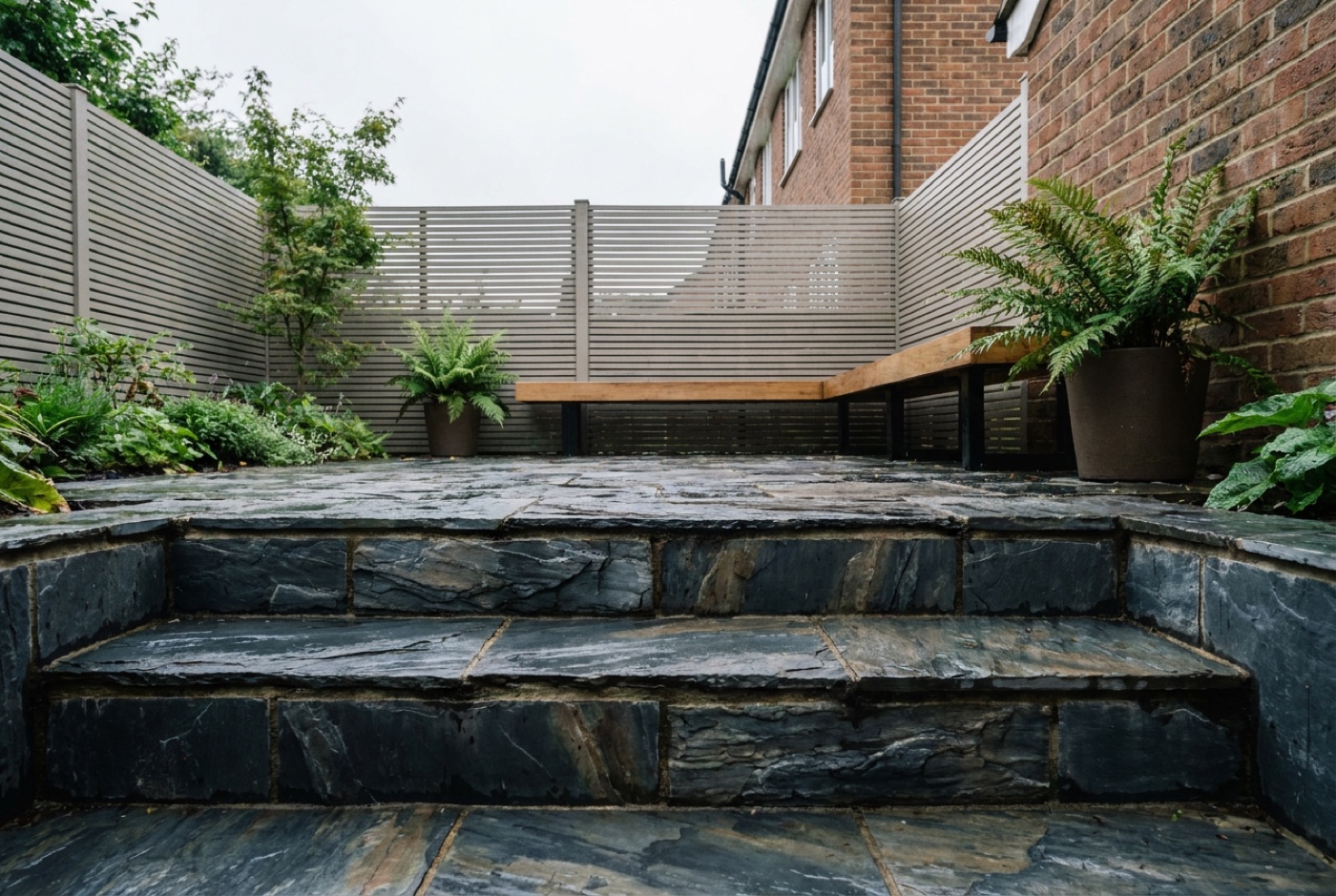
Few materials make an entrance quite like slate. Deep charcoals, blue-greys and warm mottled rusts, a naturally layered surface that catches the light, and a grip that shrugs off a wet British autumn — slate steps and paving have quietly become one of the smartest choices for a contemporary garden. Slate is dense, low-porosity and hard-wearing, which makes it far more frost-resistant than the sandstones most people default to, and its riven (naturally split) texture gives genuine underfoot security on a flight of steps. This guide covers everything that matters: what slate actually is, how it grips and lasts, when to seal it and whether to enhance the colour, where it works for steps and paving, what it costs, and how to lay and look after it so it stays looking superb for decades.
What is slate?
Slate is a fine-grained metamorphic rock formed when clay-rich mudstone is compressed and heated deep in the earth over millions of years. That process does two things that matter for a garden. First, it makes the stone extremely dense and low in porosity, so it absorbs very little water. Second, it forms slate into thin natural layers — a property called cleavage — which is why slate splits so cleanly into flat, layered sheets. Quarrymen have exploited that for centuries, which is how slate ended up on half the roofs in Wales and the Lake District.
For paving and steps, that same layered structure is a gift. Split (or “riven”) slate has a subtly rippled, textured face that grips well and reads as natural rather than machined. It’s the opposite of a flat, dead-smooth porcelain tile — every piece has a little character.
The look: dark tones, riven texture and depth
Slate’s calling card is colour and depth. Depending on where it’s quarried, it ranges from near-black and blue-grey through to warm, multi-tone slates streaked with rust, gold, green and plum. The riven surface isn’t flat — it catches light across its ripples, so a slate patio looks alive in a way a uniform surface never does. Wet it with rain (or a colour-enhancing sealer) and the tones deepen dramatically, which is exactly the drama that makes slate so popular in contemporary schemes.
Common slate looks you’ll come across:
- Black / graphite slate — near-black, formal and modern, superb against render, glass and pale planting.
- Blue-grey slate — the classic Welsh and Cumbrian tone; cool and understated.
- Multi-colour / rustic slate — mottled rust, gold and grey; warmer and busier, good for softening a contemporary space.
If you’re weighing slate against the other heavyweight naturals, our pillar guide to the best stone for garden steps puts it side by side with York, Indian sandstone, granite, porcelain and more.
Grip: why slate is good for steps
On steps, grip is the whole game, and slate earns its place here. Riven slate grips well even when wet, because the natural split leaves a textured, faintly rippled surface that gives the sole of a shoe something to bite into. That texture is why slate suits an exposed, shaded garden flight far better than a smooth, honed stone would.
A few things to keep in mind:
- Riven vs honed. As with every stone, the finish matters as much as the stone itself. Naturally riven slate is grippy; a honed or polished slate looks sleek indoors but turns slick outdoors in the rain. For an outdoor flight, always specify riven (or “natural cleft”) slate, never polished.
- Algae is the real enemy. No stone is non-slip once it’s coated in green algae. Slate’s dark colour can hide a thin biofilm, so keep treads clean — our guide to removing moss and algae from steps covers doing it safely.
- Nosings. The front edge of each tread takes the wear and the slips. A slight overhang and a crisp, well-bedded nosing improve both grip and drainage.
For a wider look at maximising traction on any material — including retrofit inserts and anti-slip treatments — see our guide to the best non-slip stone step treads.
Durability and frost resistance
This is where slate quietly outperforms the sandstones. Because it’s so dense and absorbs little water, slate is highly frost-resistant — the freeze–thaw cycle that spalls and cracks a porous, unsealed sandstone over a few British winters has much less to work with in slate. Water can’t get deep inside the stone, so it can’t expand and blow the surface apart.
That low porosity also means slate resists staining better than sandstone and won’t develop the white, powdery efflorescence that sometimes plagues cheaper paving. It’s a genuinely long-lived material; slate roofs last a century, and slate underfoot is no different.
The main durability caveat is slate’s layered structure. A poor grade of slate can flake or split along its layers — a fault called delamination — especially at exposed edges and step nosings. The fix is simple: buy quality. Reputable paving-grade slate (often Brazilian or Indian slate sold specifically for external use) is calibrated, riven and selected to resist delamination. Very cheap, thin, poorly graded slate is a false economy outdoors. As a rule, use a decent thickness for treads and don’t skimp.
| Property | How slate performs |
|---|---|
| Porosity | Low — absorbs little water |
| Frost resistance | High — copes well with UK freeze–thaw |
| Grip (riven) | Good, even when wet |
| Staining | Resists well thanks to low porosity |
| Weak point | Delamination if a poor grade is used |
| Colour | Dark, rich, deepens when wet or enhanced |
Sealing slate: do you need to, and colour-enhancing
Because slate is naturally low-porosity, it is less thirsty than sandstone and doesn’t need sealing the way a porous stone does. Plenty of slate patios are laid and left unsealed for years. But sealing slate is still worth considering, for two reasons — and one of them is purely about looks.
1. Protection. An impregnating (penetrating) sealer soaks into the stone and helps repel water, oil and dirt, making the surface easier to keep clean and slowing algae’s grip in a shaded spot. It won’t sit on top or change the texture, so it won’t reduce grip on treads.
2. Colour-enhancing (the big one for slate). This is where slate is different from every other stone. A colour-enhancing sealer deepens slate’s tones permanently — turning a slightly dusty, grey-looking dry slab into the rich, saturated, “just rained on” colour that made you buy slate in the first place. If you love how slate looks wet, a colour-enhancing sealer gives you that all the time. You can get it in a matt/natural finish or a “wet-look” gloss, though gloss finishes can be slippery, so keep any high-sheen product off the treads themselves.
A few practical notes:
- Apply to clean, fully dry stone, ideally after a dry spell. Sealing over trapped moisture can cause a hazy bloom.
- Test on a spare offcut or a hidden corner first. Colour-enhancers are a big visual change — you want to be sure you like it before committing the whole flight.
- Choose breathable sealers so the stone can still let moisture out.
Slate isn’t the only stone that benefits, and the product types overlap with what you’d use elsewhere. Our guide to the best stone sealers for steps breaks down impregnating vs topical vs colour-enhancing sealers and how to choose.
Using slate for steps and paving
Slate is versatile. Its density and grip make it excellent underfoot, and its colour makes it a natural feature material.
Slate steps
For a flight of steps, riven slate ticks the important boxes: grippy, frost-proof and dramatic. It works especially well where the steps are a focal point — a change of level running down through a modern garden, or a dark contrast against pale render and greenery. Use a good-thickness paving-grade slate for the treads, bed it properly, and specify a crisp nosing detail. Slate’s dark tone reads as deliberately contemporary, so it pairs beautifully with rendered walls, sleek lighting and architectural planting.
If you’re planning the build itself, our step-by-step guide to laying stone garden steps walks through the foundations, rise-and-going and bedding that make a flight safe and level.
Slate paving and patios
As paving, slate makes a striking patio — particularly a darker slate against timber decking, water features or a lawn. Because slate comes in a range of sizes and can be laid in single-size, mixed-size or coursed patterns, it suits both formal and relaxed layouts. Slate paddlestones and chippings also make a handsome decorative mulch in beds and between larger elements, tying a slate scheme together.
The one thing to watch on paving is surface dust — freshly split slate can shed a fine dust that washes off over the first few weeks (a colour-enhancing sealer helps knock this on the head). And because slate is dark, it shows lichen, dust and water spotting more visibly than a busy multi-tone sandstone would, so it rewards a tidy owner.
The contemporary look
Slate is arguably the most contemporary of the natural stones. Where warm riven York stone whispers “period cottage”, dark slate says “architectural, modern, considered”. That makes it a poor fit for a Victorian villa’s front steps but a brilliant one for a new extension, a courtyard, a minimalist planting scheme or any space where you want the hard landscaping to feel current. If your project is a modern one, slate and flamed granite are the two naturals to shortlist.
Slate vs other stones
How does slate stack up against the usual suspects? Briefly:
- Slate vs York stone. York is warmer, buff-grey and traditional; slate is darker, cooler and contemporary. Both are hard-wearing and grip well riven, but York is porous (seal it) while slate is naturally low-porosity. Choose by house style. Our York stone guide covers the classic option in depth.
- Slate vs Indian sandstone. Indian sandstone is cheaper and comes in warm multi-tones, but it’s porous and really needs sealing; slate is denser, more frost-resistant and darker. If you want value and warmth, sandstone; if you want drama and low porosity, slate. Our Indian sandstone guide has the full picture.
- Slate vs granite. Both are dense, frost-proof and contemporary. Flamed granite is even tougher and grips superbly; slate is more characterful and layered, and often a touch friendlier on budget. Either suits a modern garden.
- Slate vs porcelain. Porcelain is manufactured, dead-consistent and zero- maintenance; slate is natural, characterful and a little more work. It comes down to whether you want the honest variation of real stone or the fit-and-forget uniformity of a tile. Our comparison of natural stone vs porcelain vs concrete steps digs into that trade-off.
Cost
Slate typically sits in the mid-to-upper band for natural stone paving — more than budget Indian sandstone, usually less than premium reclaimed York or granite. As always, the figure moves with grade, thickness, colour and origin: calibrated, thick, external-grade slate costs more than thin, cheap slate (and is worth it for steps). Multi-colour rustic slates often cost a little more than plain blue-grey.
Two things to remember on budget. First, the material is only part of the bill — laying a flight of steps or a large patio well is skilled labour, and installation frequently costs as much as the stone, sometimes more. Second, cheap slate is a false economy outdoors, because that’s exactly the stock that delaminates. Buy a reputable external paving-grade slate and pay for the thickness. Spread over the decades it lasts, slate is excellent value.
Laying and maintenance
Slate is laid much like any natural stone paving, with a few slate-specific notes.
Laying
- Full mortar bed. Lay slate on a full mortar bed over a compacted sub-base, not on dabs or spots. Spot-bedding leaves voids that hold water and can crack slabs — and on steps, solid support under the whole tread is non-negotiable.
- Prime the back. Slate’s low porosity means mortar doesn’t always grab it strongly, so a slurry primer (a cement-based bonding coat) on the back of each slab greatly improves adhesion.
- Falls and drainage. Set a slight fall away from the house so water runs off; standing water is what feeds algae and, in winter, what freezes.
- Point the joints. Fill joints with a suitable pointing mortar or a proper jointing compound. Good joints keep water out of the sub-base and stop weeds and moss taking hold. Our guide to repointing stone steps and walls covers mixes and method if you’re refreshing tired joints.
Maintenance
Slate is low-maintenance but not no-maintenance:
- Sweep and rinse regularly to shift grit, leaves and the dust that feeds algae.
- Clean gently. A stiff brush with warm water and a mild patio cleaner handles most grime. Avoid acidic cleaners and harsh chemicals, and keep a pressure washer on a wide, low-pressure fan held well back — held too close it can erode the surface and blow out the joints. See how to clean stone steps and patios for the safe method.
- Treat algae early. A dark slate hides a thin green film, which is precisely when it’s most slippery. A biocidal patio cleaner clears it and keeps it off for months.
- Re-seal if you sealed. If you used a colour-enhancing or impregnating sealer, top it up every few years as the finish wears, so the colour stays rich and the protection stays effective.
Look after a good slate patio or flight of steps and it’ll outlast most of the rest of the garden.
FAQ
Is slate good for outdoor steps?
Yes — slate is one of the better natural stones for outdoor steps. It’s dense and low-porosity so it’s very frost-resistant, and a riven (natural cleft) finish grips well even when wet. The key is to specify riven rather than honed or polished slate for treads, use a good paving-grade thickness, and keep the surface free of algae. Avoid cheap, thin slate outdoors, as poor grades can flake.
Is slate slippery when wet?
Riven slate is not especially slippery when wet — its naturally textured, split surface gives decent grip. Polished or honed slate is a different story and does get slick outdoors, so it should never be used on exposed steps. In practice, the biggest cause of a slippery slate step isn’t the stone at all but a build-up of green algae, which makes any surface treacherous; clean it off and grip returns.
Do you need to seal slate paving?
You don’t have to. Slate’s low porosity means it copes unsealed far better than sandstone. But sealing has two benefits: an impregnating sealer makes the surface easier to clean and slows algae, and a colour-enhancing sealer deepens slate’s tones to that rich “wet-look” colour permanently. Many people seal purely for the colour. Always apply to clean, dry stone and test on an offcut first. Our stone sealer guide explains the options.
What colour does slate go when sealed?
A colour-enhancing sealer brings out slate’s full, saturated colour — the same rich, deep tones you see when it’s wet from rain. A dry, slightly dusty grey slab becomes a deep charcoal, blue-grey or warm multi-tone, depending on the slate. You can choose a natural/matt enhancer or a glossy “wet-look” one, but keep any high-gloss product off the treads, as sheen can reduce grip.
How long does slate paving last?
A very long time. Slate is one of the most durable landscaping stones — slate roofs routinely last a century, and slate underfoot is comparably long-lived. Provided you use a quality external-grade slate, bed it properly on a full mortar bed and keep it clean, a slate patio or flight of steps will easily last for decades with only light maintenance.
Is slate cheaper than sandstone or York stone?
Slate usually costs more than budget Indian sandstone but less than premium reclaimed York stone, placing it in the mid-to-upper band. External paving-grade slate (which is what you want for steps) costs more than thin, cheap slate, and rustic multi-colour slates often carry a small premium over plain blue-grey. Factor in skilled installation, which can match the material cost — but spread over slate’s long life, it’s strong value.
For the bigger picture, compare slate against every other option in our pillar guide to the best stone for garden steps, or read up on the traditional alternative in our York stone steps and paving guide.