Garden Step Dimensions: The Right Rise & Going (UK Guide)
Garden step dimensions made simple: the ideal rise (100–150mm), going (300mm+), the 2R+G rule, step width, fall for drainage and a worked example.
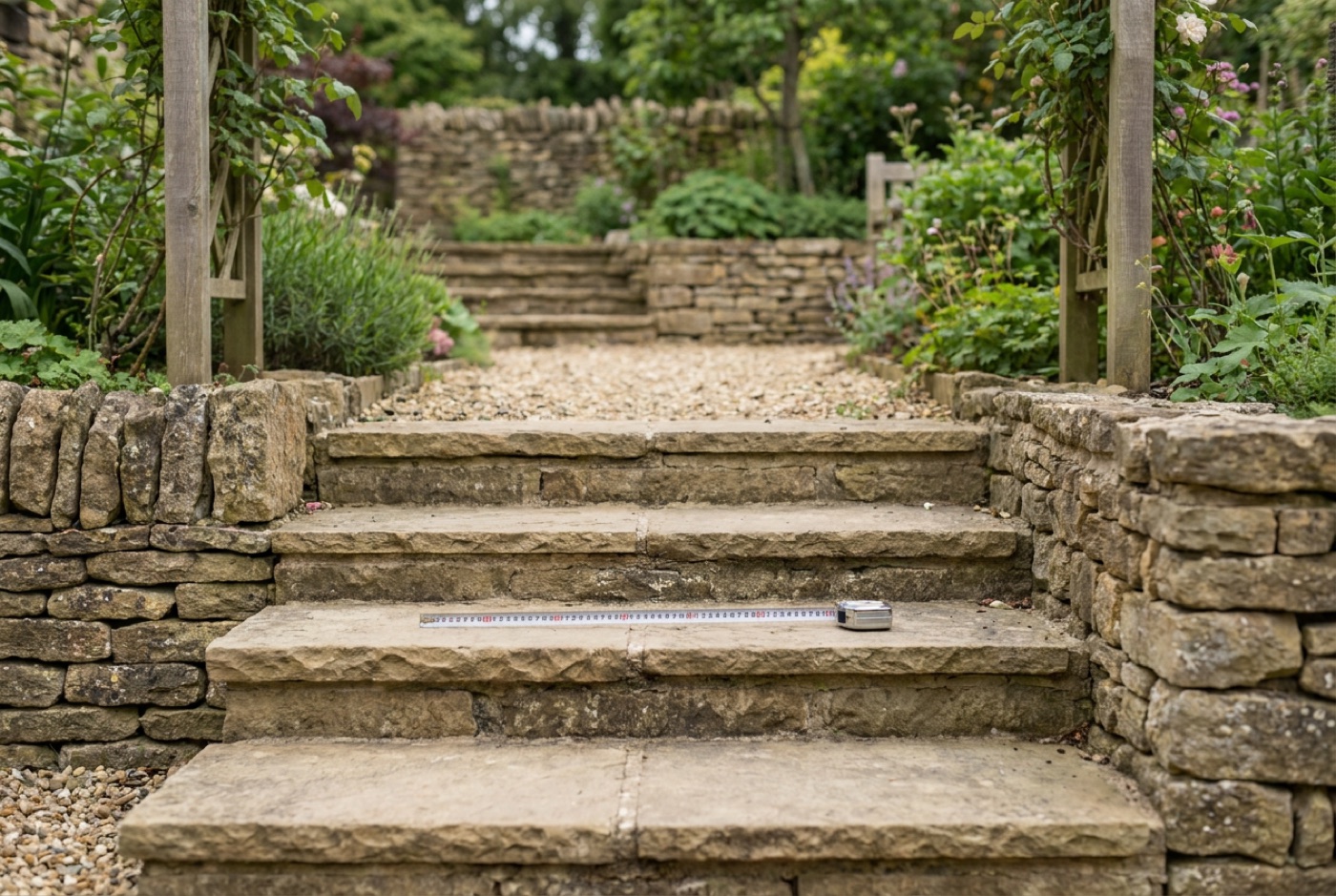
Getting the garden step dimensions right is the single thing that separates a flight that feels effortless from one that trips people every time they use it. Outdoor steps are gentler and deeper than the ones inside your house — a comfortable garden step wants a rise of 100–150mm and a going of at least 300mm, with every step in the flight kept exactly the same. Get those numbers right (and keep them consistent) and you barely notice the steps; get them wrong and your legs feel it on the way up and your ankles feel it on the way down. This guide covers rise, going, the 2R+G comfort rule, width, fall for drainage and how to work out the number of steps for any slope — with a worked example you can copy.
The two numbers that matter: rise and going
Every step is defined by two measurements, and almost everything else follows from them.
- Rise — the vertical height you climb from the top of one tread to the top of the next. It’s how far your foot lifts on each step.
- Going — the horizontal depth of the tread you actually step onto, measured from the front (nosing) of one step to the front of the next. It’s how much room your foot has to land.
Don’t confuse “going” with the full physical depth of the slab. If your treads overlap (a nosing that projects over the riser below), the going is the front-to-front distance, not the slab width. For garden steps we usually build without an overhang, so the going and the tread depth are the same — which keeps the maths simple.
Comfortable rise and going for garden steps
Indoor stairs are steep because space is tight — a domestic staircase can run a rise up to about 220mm. Outdoors you have room, gravity to fight on wet days, and people carrying shopping, pushing wheelbarrows or walking dogs, so garden steps should always be shallower and deeper.
| Measurement | Comfortable range | Sweet spot | Notes |
|---|---|---|---|
| Rise (height) | 100–150mm | ~120–140mm | Lower = gentler; never mix heights in one flight |
| Going (depth) | 300mm minimum | 350–450mm | Deeper feels relaxed; very deep may need two paces |
| Width | 600mm+ (one person) | 900–1200mm | 1500mm lets two people pass comfortably |
| Fall (cross/forward) | 1:60 to 1:40 | ~2–3mm per tread | Sheds water so it never pools or freezes |
A rise of around 120–140mm with a going of 350–400mm is the classic “garden” feel — the kind of steps you drift up without thinking. Push the rise down towards 100mm on a shallow slope and you get an even more generous, stroll-up-the-garden staircase.
Why outdoor steps are shallower than indoor ones
Three reasons. First, safety: wet, mossy or frosty stone is far less forgiving than a dry carpeted tread, so a lower rise gives more margin. Second, comfort: you’re often carrying things or walking with company outdoors. Third, sightlines — a shallow flight reads as part of the landscape rather than an obstacle. If your garden steps ever start feeling like indoor stairs, your rise is too high.
The 2R + G rule (the comfort formula)
There’s a simple, long-established rule of thumb that ties rise and going together so the step “fits” a natural stride:
2 × Rise + Going = 550mm to 700mm
The idea is that as you make a step taller (bigger rise) you should make it shallower (smaller going), and vice versa, so the effort of lifting your foot and the length of your stride stay balanced. Roughly 600–650mm is the comfortable target for garden steps.
Let’s test a few combinations:
| Rise | Going | 2R + G | Verdict |
|---|---|---|---|
| 120mm | 400mm | 640mm | Ideal — relaxed garden step |
| 140mm | 340mm | 620mm | Comfortable |
| 150mm | 300mm | 600mm | Fine, at the steeper end |
| 170mm | 280mm | 620mm | Formula OK, but rise too high for a garden |
| 100mm | 450mm | 650mm | Very gentle — lovely on a shallow slope |
Notice the formula alone isn’t enough: 170mm + 280mm lands inside the 2R+G
window but breaks the garden rise limit. Treat 2R+G as a comfort check on top
of the 100–150mm rise and 300mm+ going limits, not a replacement for them.
Keep every step identical
This is the rule people most often break, and it’s the most dangerous. Your brain learns the rhythm of a flight after the first step or two and stops looking down. If one step is even 15–20mm taller or shallower than the rest, that’s exactly the one that catches a toe or turns an ankle — usually on the way down, when you have momentum.
- Divide the total rise equally so every step is the same height (we show how below).
- Keep every going the same too — don’t let one tread creep deeper because a slab happened to be bigger.
- The classic mistake is the bottom or top step ending up a different height because the levels weren’t checked. Sort your levels first, then divide.
If you’re building the flight yourself, our step-by-step guide to laying stone garden steps walks through setting out equal risers on site.
Step width
Width is about how the steps will actually be used:
- 600mm — the practical minimum for one person, and fine for a narrow utility path down the side of a house.
- 900–1200mm — comfortable for a main garden route; one person with a wheelbarrow, or two people not quite side by side.
- 1500mm and up — lets two people walk or pass comfortably, and gives a generous, welcoming feel for a front-of-house or entertaining space.
Wider steps also look calmer and more expensive, so if a flight is a focal point it’s usually worth stealing extra width. Just remember wider treads mean more stone and a bigger, better-drained base underneath — and the more stone you buy, the more the choice of stone type and cost matters.
Fall: don’t build a flat tread
A tread that’s dead level holds water. Water sits, then freezes, then works into the stone and the joints and cracks them — the number-one killer of otherwise sound steps. So every tread needs a tiny, deliberate slope to shed rain:
- Build in a forward fall of about 2–3mm across the depth of each tread (very roughly a 1:40 to 1:60 gradient) so water runs off the nosing rather than pooling or draining back into the riser.
- On wide steps you can fall the water gently to one side instead, towards a border or drainage channel.
- The slope should be small enough that you never feel it underfoot but enough that a bucket of water clears the tread on its own.
This tiny detail is why well-built stone steps last for generations while flat ones spall and crack. It matters just as much for brick garden steps, where standing water attacks the mortar joints first.
How to calculate the number of steps for a slope
Here’s the method that turns a bank in your garden into a set of dimensions.
- Measure the total rise. Set a long, level straight-edge (or a taut line with a spirit level or line level) from the top of the slope out to where the bottom step will finish, and measure straight down to the ground. That vertical drop is your total rise.
- Measure the total run. Measure the horizontal distance the same line covers, from the top of the slope to the front of the bottom step. That’s the length you have to fit the flight into.
- Divide the total rise by your target step height (say 130mm) to get a rough number of steps. Round to a whole number.
- Divide the total rise by that whole number of steps to get the exact rise per step — this is what keeps every step identical.
- Divide the total run by the number of goings to check your going. (A flight with N risers has N−1 goings between treads, plus the bottom tread landing — in practice, run ÷ number of treads is a good working check.)
- Sense-check with 2R+G and against the 100–150mm / 300mm+ limits.
Worked example
Say you’ve measured a garden bank and found:
- Total rise: 900mm
- Total run available: 2400mm
Number of steps: 900 ÷ 130 (target rise) = 6.9, so round to 7 steps.
Exact rise per step: 900 ÷ 7 = 128.6mm — call it ~129mm, comfortably in the 100–150mm range and identical on every step.
Going: with 2400mm of run over 7 treads, 2400 ÷ 7 = ~343mm per going — above the 300mm minimum, so it’s comfortable. (If you’d only had, say, 1800mm of run, 1800 ÷ 7 = 257mm — too shallow. You’d either steal more run by starting the bottom step further out, or accept fewer, taller steps.)
2R+G check: (2 × 129) + 343 = 601mm — inside the 550–700mm comfort band.
So the answer is a 7-step flight, 129mm rise, ~343mm going — every step the same. That’s a genuinely comfortable garden staircase, and every number came straight off the slope.
When the run is too short
If the horizontal run won’t give you a 300mm+ going, you have three honest options:
- Extend the run — start the bottom step further into the garden, or cut back into the top of the bank, to buy more horizontal distance.
- Break the flight with a landing — split a tall bank into two shorter flights with a level landing between them (a good idea on any flight climbing more than about 1.8m anyway).
- Terrace the slope — turn a steep bank into a series of level beds with short step-ups between, which often looks better than one long, steep staircase.
Never solve a short run by simply making the treads shallower than 300mm — that’s where trips come from.
Landings, handrails and steeper flights
Longer or steeper flights bring extra considerations that go beyond pure dimensions:
- Landings break up a long climb and give somewhere to pause; a landing should be at least as deep as the flight is wide, and ideally the length of a full stride or two (around 1200mm+).
- Handrails become worth fitting on anything more than a few steps, especially where the flight is used in the dark or by less steady visitors.
- Consistent nosings and good contrast at the front edge help people judge each step — important as light fades.
For anything approaching a main access route to a property, it’s worth checking whether the rules that apply to steps and stairs come into play. Our guide to whether garden steps need building regs explains where the line sits between a purely landscape flight and steps that form part of a building’s access.
Quick reference: garden step dimensions
| Element | Recommended | Absolute limits |
|---|---|---|
| Rise per step | 120–140mm | 100–150mm; never mix in one flight |
| Going (tread depth) | 350–400mm | 300mm minimum |
| Step width (main route) | 900–1200mm | 600mm minimum |
| Consistency | All steps identical | ±0mm is the goal |
| Fall for drainage | 2–3mm forward per tread | Never build a flat tread |
| Comfort check | 2R + G ≈ 600–650mm | 550–700mm |
Pin those numbers up before you set out a single string line and your flight will feel right the first time you walk it.
FAQ
What is the ideal rise and going for garden steps?
For outdoor garden steps, aim for a rise (height) of 100–150mm — around 120–140mm is the sweet spot — and a going (tread depth) of at least 300mm, ideally 350–400mm. Keep every step in the flight identical, and check the pairing with the 2R+G rule (2 × rise + going ≈ 600–650mm). Those figures give a gentle, comfortable staircase that suits the way we actually use gardens.
What is the 2R + G rule for steps?
It’s a comfort formula: two times the rise plus the going should total roughly 550–700mm (about 600–650mm is ideal). The logic is that a taller step should have a shallower tread, and a shorter step a deeper one, so the effort of each stride stays balanced. Use it as a check on top of the standard rise and going limits, not as a replacement — a step can pass 2R+G while still having a rise that’s too high for a garden.
How deep should a garden step be?
The going — the part your foot lands on — should be at least 300mm, and 350–450mm feels more relaxed for a garden setting. Below 300mm your heel overhangs the edge and the step feels precarious, especially going down. If your available run won’t allow a 300mm going, extend the run or add a landing rather than building shallow, trip-prone treads.
How do I work out how many steps I need for a slope?
Measure the total vertical rise of the slope, then divide it by your target step height (say 130mm) and round to a whole number of steps. Divide the total rise by that whole number again to get the exact, equal rise per step. Finally divide the horizontal run by the number of treads to check the going clears 300mm, and confirm the pair with 2R+G. There’s a full worked example above.
Can garden steps have different heights?
No — every step in a flight should be exactly the same rise. Your brain learns the rhythm of a staircase after a step or two and stops looking down, so a single odd-height step is the one that catches a toe or turns an ankle. If levels force a change, absorb it into a landing between two separate, internally-consistent flights rather than into one mismatched step.
How wide should garden steps be?
600mm is the practical minimum for one person and a narrow side path. For a main garden route aim for 900–1200mm so someone can pass with a wheelbarrow, and 1500mm or more if you want two people to walk or pass comfortably. Wider steps also look more generous and expensive, so it’s often worth the extra stone on a focal flight.